History
Created by John Holland in the 1960s, it was formally published in the book Adaptation in Natural and Artificial Systems (1975, MIT). It was inspired by Darwin's theory of evolution, where each individual is a possible solution, and it is called a chromosome.
Representation
Depending on the problem, the chromosome (individual), can be modeled as:
A function-minimization problem can model the individual as a binary chromosome. A neural network can be trained using Genetic Algorithm by modeling the weights of its neurons as a chromosome of real values. The Travelling Salesman Problem (TSP) must be modeled as a permutation, where each number represents one possible city. An AST (Abstract Syntax Tree) can be used to generate code for some problem (better known as Genetic Programming). There are many ways to model a specific problem in a chromosome.
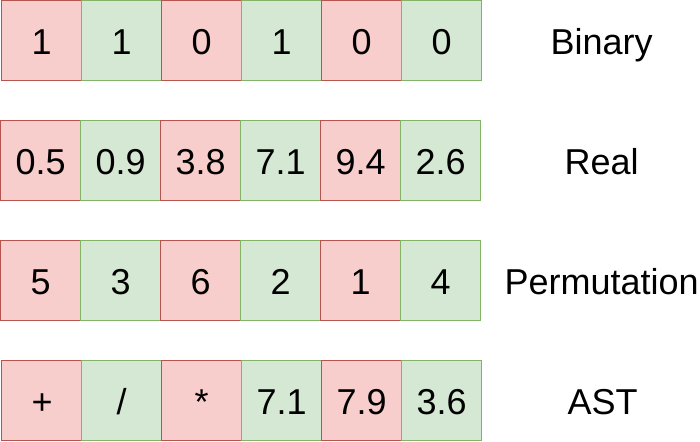 |
| Some possible ways of representing the individual's information in a chromosome. |
The Algorithm
def genetic_algorithm(n):
    population = init_population(n)
    for _ in xrange(epochs):
        fn = fitness(population)
        parents = selection(n, fn)
        offspring = crossover(parents)
        offspring = mutation(offspring)
        population = parents + offspring
    return best(population)
Pseudo-code of genetic algorithm.
Population Initialization
Given \(n\) as the number of desired individuals, this function must return a list of \(n\) individuals.
Fitness
The fitness function evaluates each individual, giving to it a number representing its fitness.
Selection
The selection function should select a number of better individuals from the population based on its fitness values. This number is selected empirically. For future explanation let's call it as \(\alpha\).
Crossover
With the \(\alpha\) selected individuals, i.e. the parents. From them the offspring will be generated, somehow combining two random parental chromosomes.
Depending on the problem, there are many ways to combine them. A simpler way is to select the first \(k\) elements of the first parent and \(l-k\) elements from the other parent where \(l\) is the chromosome length.
But, this approach is a bit random, turning the algorithm into an inefficient random search. For example, it is more acceptable to use the approach below as a crossover function for the TSP:
Where it selects a random piece from the parent \(A\) chromosome and then copies it to the offspring in the same order and position. To complete the offspring chromosome, the parent \(B\) chromosome is iterated over, filling the offspring if that value is not yet present.
Note that \(n - \alpha\) offspring should be generated from the parents to complete the original size of the population.
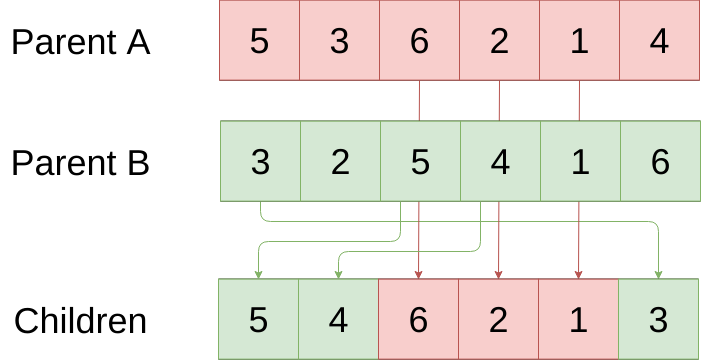 |
| The Order Crossover: a more acceptable crossover for the TSP. |
Mutation
To increase the search area, random perturbations are made on the offspring chromosomes, and again, it depends on the type of problem the way this is done.
Application Examples
Function Minimization
|
|
| Optimizing a function with genetic algorithm. |
entscheidungsproblem.
Below is the best individual at each epoch:
EPOCH       FITNESS              CHROMOSOME
#0            86            dktzmkeqixkmpzskjqjn
#1            85            enstfgzpbwrcxoosnfbh
#2            78            jetvbgqcbpceqtnnctdm
#3            66            cpujjdaldsjhuuoraejn
#4            55            enurcichvsoepthmckeh
#5            44            enstfggohqnewnoncmkk
#6            43            bosqbgigbwrculrqcmkm
#7            38            enstfggohqnevqsqcmcj
#8            38            enstfggohqnevqsqcmcj
#9            36            enstdkfkdpnjxqxqalbl
#10           32            eosqbhhibwmfzqspbhdp
#11           27            enstbkbhetogvqsqcmcj
#12           27            enstbkbhetogvqsqcmcj
#13           25            enstbgcidypgwnunbmdl
#14           23            enstcecidupgvqsqcmcj
#15           21            enurcichdqneqosqcmdm
#16           21            enurcichdqneqosqcmdm
#17           17            enstfgcidtoesospbldn
#18           14            enttceciduoesospbldn
#19           14            enttceciduoesospbldn
#20           14            enttceciduoesospbldn
#21           10            enurcheidtoesospblel
#22           10            enurcheidtoesospblel
#23           10            enurcheidtoesospblel
#24           10            enurcheidtoesospblel
#25           10            enurcheidtoesospblel
#26           9             enurcheidungvqrobjel
#27           8             enurcheidwngsospblel
#28           7             enttcieiduogsospblel
#29           6             ensscheidungsospbldn
#30           6             ensscheidungsospbldn
#31           6             ensscheidungsospbldn
#32           4             enttcheidungsospblem
#33           4             enttcheidungsospblem
#34           4             enttcheidungsospblem
#35           3             entrcheiduogsoroblem
#36           3             entrcheiduogsoroblem
#37           2             enuscheidungsoroblem
#38           1             entscheidungsoroblem
#39           1             entscheidungsoroblem
#40           1             entscheidungsoroblem
#41           1             entscheidungsoroblem
#42           1             entscheidungsoroblem
#43           1             entscheidungsoroblem
#44           1             entscheidungsoroblem
#45           1             entscheidungsoroblem
#46           1             entscheidungsoroblem
#47           0             entscheidungsproblem
#48           0             entscheidungsproblem
#49           0             entscheidungsproblem
#50           0             entscheidungsproblem
Results of genetic algorithm.
Traveling Salesman Problem
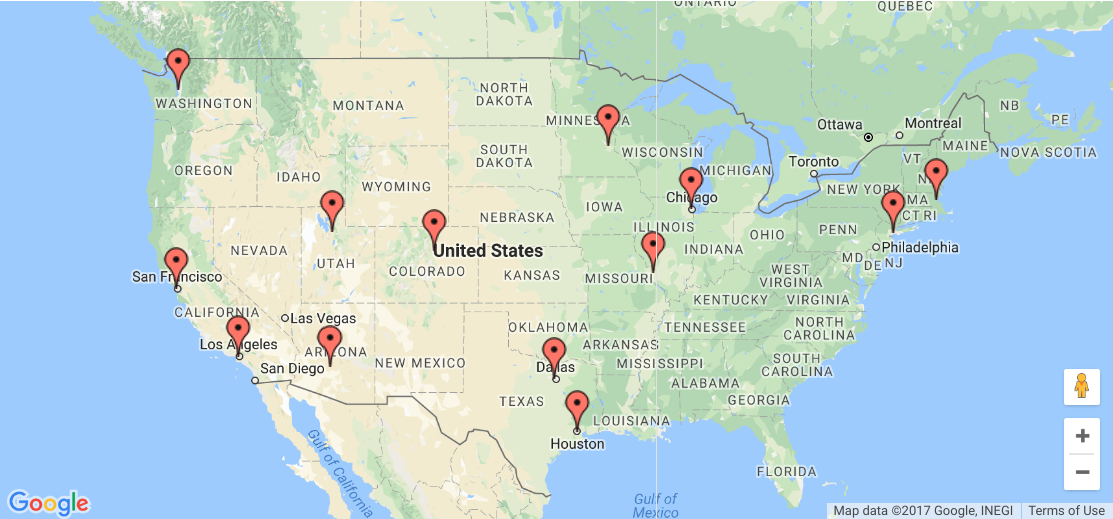 |
| Map of the cities in sample data. |
city_distance = [
    [   0, 2451,  713, 1018, 1631, 1374, 2408,  213, 2571,  875, 1420, 2145, 1972], # New York
    [2451,    0, 1745, 1524,  831, 1240,  959, 2596,  403, 1589, 1374,  357,  579], # Los Angeles
    [ 713, 1745,    0,  355,  920,  803, 1737,  851, 1858,  262,  940, 1453, 1260], # Chicago
    [1018, 1524,  355,    0,  700,  862, 1395, 1123, 1584,  466, 1056, 1280,  987], # Minneapolis
    [1631,  831,  920,  700,    0,  663, 1021, 1769,  949,  796,  879,  586,  371], # Denver
    [1374, 1240,  803,  862,  663,    0, 1681, 1551, 1765,  547,  225,  887,  999], # Dallas
    [2408,  959, 1737, 1395, 1021, 1681,    0, 2493,  678, 1724, 1891, 1114,  701], # Seattle
    [ 213, 2596,  851, 1123, 1769, 1551, 2493,    0, 2699, 1038, 1605, 2300, 2099], # Boston
    [2571,  403, 1858, 1584,  949, 1765,  678, 2699,    0, 1744, 1645,  653,  600], # San Francisco
    [ 875, 1589,  262,  466,  796,  547, 1724, 1038, 1744,    0,  679, 1272, 1162], # St. Louis
    [1420, 1374,  940, 1056,  879,  225, 1891, 1605, 1645,  679,    0, 1017, 1200], # Houston
    [2145,  357, 1453, 1280,  586,  887, 1114, 2300,  653, 1272, 1017,    0,  504], # Phoenix
    [1972,  579, 1260,  987,  371,  999,  701, 2099,  600, 1162,  1200,  504,   0]] # Salt Lake City
Distance matrix between some cities of USA.
Running the genetic algorithm, the best individuals of each epoch and its fitness is shown below:
EPOCH       FITNESS                            CHROMOSOME
#0            10279           [8, 6, 12, 1, 11, 9, 2, 0, 7, 5, 10, 3, 4]
#1            9972            [7, 0, 2, 9, 3, 5, 11, 6, 8, 1, 4, 12, 10]
#2            9972            [7, 0, 2, 9, 3, 5, 11, 6, 8, 1, 4, 12, 10]
#3            9759            [9, 2, 12, 11, 1, 8, 6, 4, 10, 5, 3, 7, 0]
#4            9509            [8, 6, 1, 11, 4, 10, 5, 9, 7, 0, 2, 3, 12]
#5            9309            [7, 0, 2, 4, 9, 3, 5, 10, 12, 11, 1, 8, 6]
#6            9161            [0, 7, 3, 2, 9, 5, 10, 11, 6, 1, 8, 12, 4]
#7            9161            [0, 7, 3, 2, 9, 5, 10, 11, 6, 1, 8, 12, 4]
#8            9161            [0, 7, 3, 2, 9, 5, 10, 11, 6, 1, 8, 12, 4]
#9            8605            [10, 5, 11, 1, 8, 6, 12, 4, 3, 7, 0, 2, 9]
#10           8605            [10, 5, 11, 1, 8, 6, 12, 4, 3, 7, 0, 2, 9]
#11           8605            [10, 5, 11, 1, 8, 6, 12, 4, 3, 7, 0, 2, 9]
#12           8464            [6, 8, 11, 1, 12, 4, 3, 10, 5, 9, 2, 7, 0]
#13           8464            [6, 8, 11, 1, 12, 4, 3, 10, 5, 9, 2, 7, 0]
#14           8464            [6, 8, 11, 1, 12, 4, 3, 10, 5, 9, 2, 7, 0]
#15           8464            [6, 8, 11, 1, 12, 4, 3, 10, 5, 9, 2, 7, 0]
#16           8139            [0, 7, 2, 9, 5, 10, 3, 4, 12, 11, 1, 8, 6]
#17           8139            [0, 7, 2, 9, 5, 10, 3, 4, 12, 11, 1, 8, 6]
#18           8139            [0, 7, 2, 9, 5, 10, 3, 4, 12, 11, 1, 8, 6]
#19           8139            [0, 7, 2, 9, 5, 10, 3, 4, 12, 11, 1, 8, 6]
#20           8139            [0, 7, 2, 9, 5, 10, 3, 4, 12, 11, 1, 8, 6]
#21           8139            [0, 7, 2, 9, 5, 10, 3, 4, 12, 11, 1, 8, 6]
#22           7737            [6, 8, 1, 11, 12, 4, 5, 10, 9, 3, 2, 7, 0]
#23           7737            [6, 8, 1, 11, 12, 4, 5, 10, 9, 3, 2, 7, 0]
#24           7737            [6, 8, 1, 11, 12, 4, 5, 10, 9, 3, 2, 7, 0]
#25           7599            [7, 0, 2, 3, 9, 10, 5, 4, 12, 11, 1, 8, 6]
#26           7599            [7, 0, 2, 3, 9, 10, 5, 4, 12, 11, 1, 8, 6]
#27           7599            [7, 0, 2, 3, 9, 10, 5, 4, 12, 11, 1, 8, 6]
#28           7599            [7, 0, 2, 3, 9, 10, 5, 4, 12, 11, 1, 8, 6]
#29           7599            [7, 0, 2, 3, 9, 10, 5, 4, 12, 11, 1, 8, 6]
#30           7599            [7, 0, 2, 3, 9, 10, 5, 4, 12, 11, 1, 8, 6]
Result of the genetic algorithm for the TSP problem.
Art
We can even make some art by trying to imitate a painting. The images below were generated by a genetic algorithm where each individual has in its chromosome the size, points and colors of one circle/polygon. The best individual is drawn. Then, another batch of epochs is performed with the updated image, trying to minimize the difference from the real image.
Using this work as inspiration, the source code available here tries to draw the picture of Lena with circles. One of the results is in the figure below:
Instead of circles, the source code available here uses polygons and one of the results is in the figure below:
To obtain a more similar image, the algorithm must have its parameters altered, for example increasing the number of epochs and individuals, which will obviously lead to the algorithm taking more execution time.
Checkout the code on GitHub.
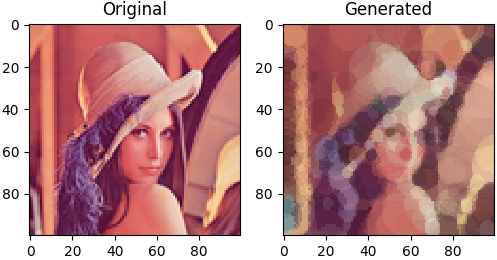 |
| Result trying to draw the left image with circles. |
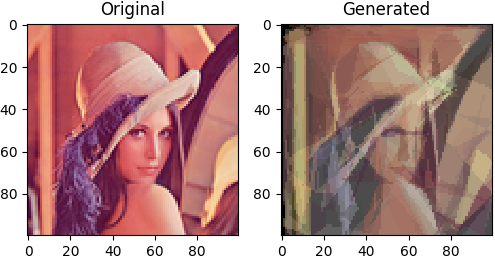 |
| Result trying to draw the left image with polygons. |
Checkout the code on GitHub.
Comments